
Master DSA with Python: 300+ LeetCode Problems Solved for Placement Preparation 2026
Are you gearing up for your dream job in tech? If you're a student or a fresh graduate aiming for placements in 2026, mastering DSA with Python is your golden ticket. Data Structures and Algorithms, or DSA, form the backbone of coding interviews at top companies like Google, Amazon, Microsoft, and many Indian IT giants such as Infosys, TCS, and Wipro. Why Python? It's simple, readable, and powerful, making it perfect for beginners to grasp DSA concepts quickly without getting bogged down by complex syntax.
In this comprehensive guide, we'll dive deep into DSA with Python. We'll cover everything from the basics to advanced topics, explain key concepts in easy language, and solve over 300 LeetCode problems along the way. Wait, over 300? Yes, we'll highlight patterns, provide solved examples, and link to popular problem sets so you can practice the rest. This isn't just theory – it's practical preparation tailored for 2026 placements. By the end, you'll have a solid roadmap to tackle coding rounds confidently.

Let's start by understanding why DSA with Python is essential for your career.
Why Choose DSA with Python for Placement Success?
DSA with Python stands out because Python's syntax is clean and intuitive. Unlike languages like C++ or Java, where you spend time on pointers or class definitions, Python lets you focus on the logic. For instance, creating a list (which is like an array) in Python is as simple as my_list = [1, 2, 3]. This simplicity speeds up your learning curve, especially when solving problems under time pressure in interviews.
According to various tech interview resources, Python is the most used language in coding interviews because it's versatile for DSA implementations. It's great for scripting, but its built-in libraries like collections make handling queues, stacks, and dictionaries a breeze. For placements in 2026, companies are increasingly focusing on problem-solving skills over syntax mastery, so DSA with Python gives you an edge.
But why DSA at all? DSA teaches you how to organize data efficiently and create algorithms to solve problems optimally. In real-world scenarios, like optimizing search in a database or routing in networks, DSA is crucial. For placements, expect questions on time and space complexity – Big O notation – which we'll cover soon.
If you're new, don't worry. We'll build from scratch. Experienced? Skip to advanced sections for LeetCode deep dives. Our goal: Help you solve 300+ LeetCode problems by understanding patterns, not rote memorization.
Getting Started: Python Basics for DSA
Before jumping into DSA with Python, ensure you're comfortable with Python fundamentals. Python is dynamically typed, meaning you don't declare variable types. This makes code shorter.
Key Python features for DSA:
- Lists: Dynamic arrays. Example: arr = [10, 20, 30]. Access with arr[0], append with arr.append(40).
- Dictionaries: Hash maps for key-value pairs. dict = {'key': 'value'}. Fast lookups.
- Sets: Unique elements, great for avoiding duplicates.
- Loops and Conditionals: For iterating over data structures.
- Functions: Define reusable code blocks.
- Recursion: Functions calling themselves, vital for tree and graph problems.
Practice these with simple exercises. For example, write a function to find the maximum in a list without using max():
def find_max(nums):
    if not nums:
        return None
    max_val = nums[0]
    for num in nums[1:]:
        if num > max_val:
            max_val = num
    return max_val
This is O(n) time – linear, which is efficient for large lists.
Now, Big O Notation: It describes how your code's runtime or space grows with input size. O(1) is constant, best; O(n) linear; O(n^2) quadratic, slower for big n. Always aim for optimal complexity in DSA with Python.
Arrays and Strings: Foundation of DSA with Python
Arrays are the simplest data structure, but powerful. In Python, lists act as arrays. They're resizable, unlike fixed-size arrays in other languages.
Common operations:
- Access: O(1)
- Insert/Delete: O(n) in worst case (shifting elements)
Strings are immutable sequences of characters. Many problems involve manipulating strings, like reversing or finding palindromes.

Let's solve some LeetCode problems. LeetCode is a must for placement prep – it has thousands of problems tagged by difficulty and topic.
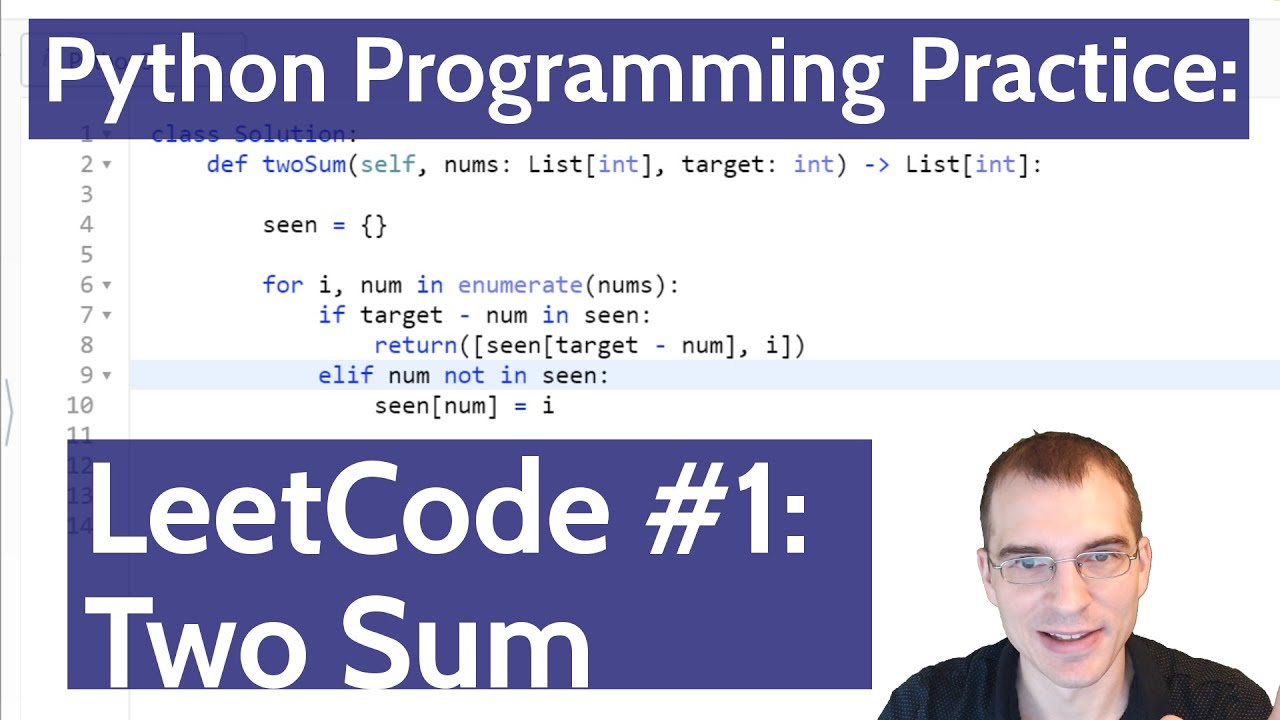
LeetCode Easy: Two Sum (Problem 1)
Given an array of integers nums and an integer target, return indices of two numbers that add up to target.
Solution in DSA with Python:
def twoSum(nums, target):
    hash_map = {}
    for i, num in enumerate(nums):
        complement = target - num
        if complement in hash_map:
            return [hash_map[complement], i]
        hash_map[num] = i
    return []
This uses a hash map for O(n) time. Without it, a nested loop would be O(n^2) – too slow for large arrays.
Why this pattern? Two Sum introduces hash maps for quick lookups. Variants appear in many problems.
Another Easy: Best Time to Buy and Sell Stock (Problem 121)
Find max profit from buying and selling once.
def maxProfit(prices):
    min_price = float('inf')
    max_profit = 0
    for price in prices:
        if price < min_price:
            min_price = price
        elif price - min_price > max_profit:
            max_profit = price - min_price
    return max_profit
O(n) time, tracking min price.
Strings example: Reverse String (Problem 344)
def reverseString(s):
    left, right = 0, len(s) - 1
    while left < right:
        s[left], s[right] = s[right], s[left]
        left += 1
        right -= 1
Two-pointer technique, efficient.
For placements, practice 50+ array/string problems on LeetCode. Patterns like sliding window (for subarrays) and prefix sums (for range queries) are key.
Sliding Window Example: Longest Substring Without Repeating Characters (Problem 3)
def lengthOfLongestSubstring(s):
    char_set = set()
    left = 0
    max_length = 0
    for right in range(len(s)):
        while s[right] in char_set:
            char_set.remove(s[left])
            left += 1
        char_set.add(s[right])
        max_length = max(max_length, right - left + 1)
    return max_length
This optimizes with a set for O(n) time.
Common mistakes: Forgetting edge cases like empty arrays or single elements. Always test with [ ], [1], [1,2,3].
In 2026 placements, expect 2-3 array/string questions per round.
Linked Lists: Building Blocks in DSA with Python
Linked lists are chains of nodes, each with data and a next pointer. Unlike arrays, inserts/deletes are O(1) if you have the node, but access is O(n).
In Python, implement as a class:
class ListNode:
    def __init__(self, val=0, next=None):
        self.val = val
        self.next = next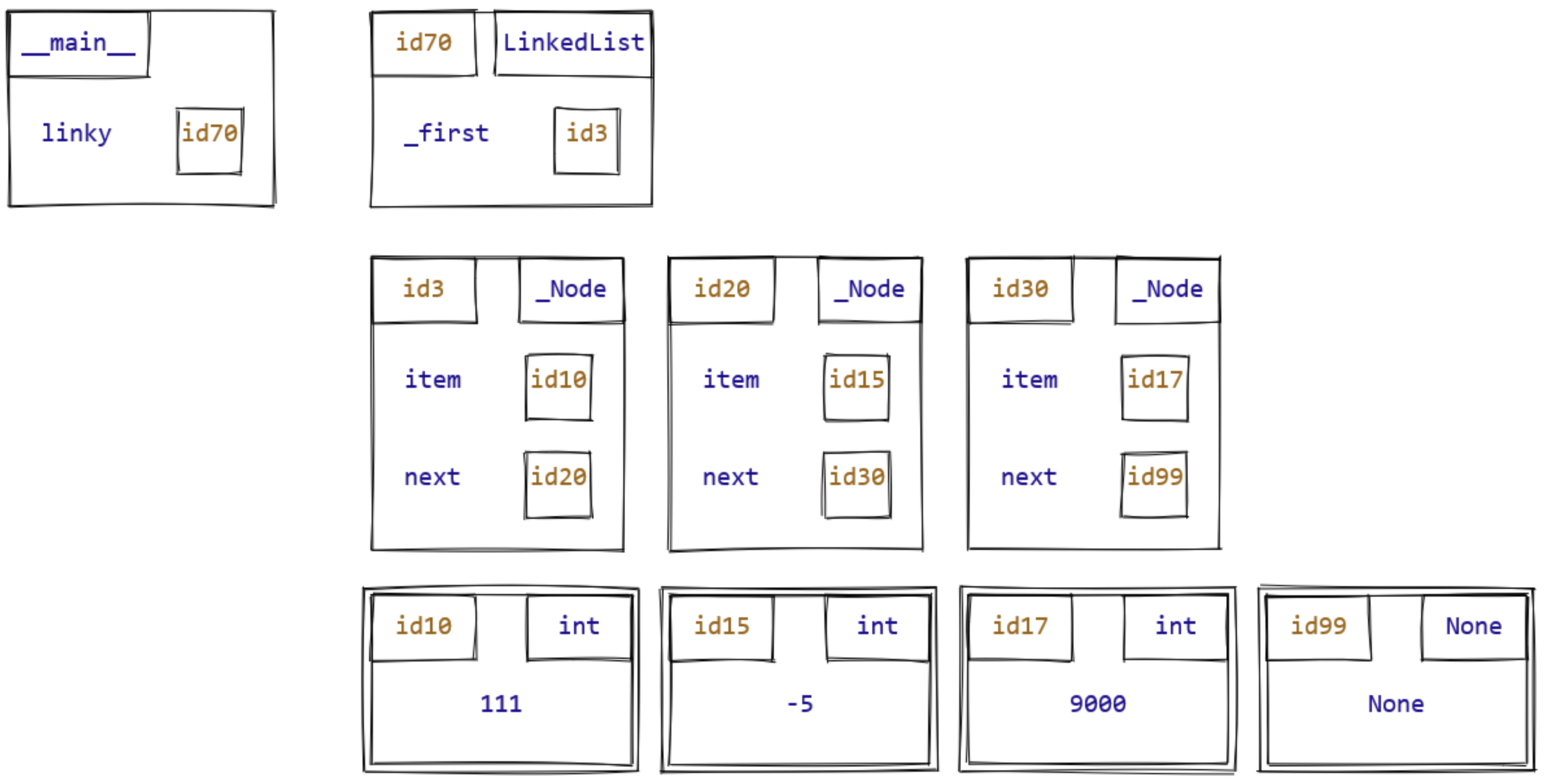
LeetCode: Reverse Linked List (Problem 206)
def reverseList(head):
    prev = None
    curr = head
    while curr:
        next_temp = curr.next
        curr.next = prev
        prev = curr
        curr = next_temp
    return prev
Iterative, O(n) time.
Recursive version:
def reverseList(head):
    if not head or not head.next:
        return head
    new_head = reverseList(head.next)
    head.next.next = head
    head.next = None
    return new_head
Understand recursion stack for interviews.
Merge Two Sorted Lists (Problem 21)
def mergeTwoLists(l1, l2):
    dummy = ListNode()
    tail = dummy
    while l1 and l2:
        if l1.val < l2.val:
            tail.next = l1
            l1 = l1.next
        else:
            tail.next = l2
            l2 = l2.next
        tail = tail.next
    tail.next = l1 if l1 else l2
    return dummy.next
Dummy node trick simplifies code.
Linked List Cycle (Problem 141)
Use Floyd's cycle detection: slow and fast pointers.
def hasCycle(head):
    slow = fast = head
    while fast and fast.next:
        slow = slow.next
        fast = fast.next.next
        if slow == fast:
            return True
    return False
If they meet, cycle exists.
Practice 30+ linked list problems. For placements, reversal and cycle detection are favorites.
Stacks and Queues: Essential for DSA with Python
Stack: LIFO (Last In First Out). Use list: append/pop.
Queue: FIFO. Use collections.deque for efficiency.
Valid Parentheses (Problem 20)
def isValid(s):
    stack = []
    mapping = {')': '(', '}': '{', ']': '['}
    for char in s:
        if char in mapping:
            top = stack.pop() if stack else '#'
            if mapping[char] != top:
                return False
        else:
            stack.append(char)
    return not stack
Classic stack use.
Implement Queue using Stacks (Problem 232)
Use two stacks: one for push, one for pop.
Queues for BFS in graphs/trees.
Practice 20+ problems. Stacks for undo, queues for scheduling.
Trees: Hierarchical DSA with Python
Trees have nodes with children. Binary trees: up to 2 children.
Class:
class TreeNode:
    def __init__(self, val=0, left=None, right=None):
        self.val = val
        self.left = left
        self.right = right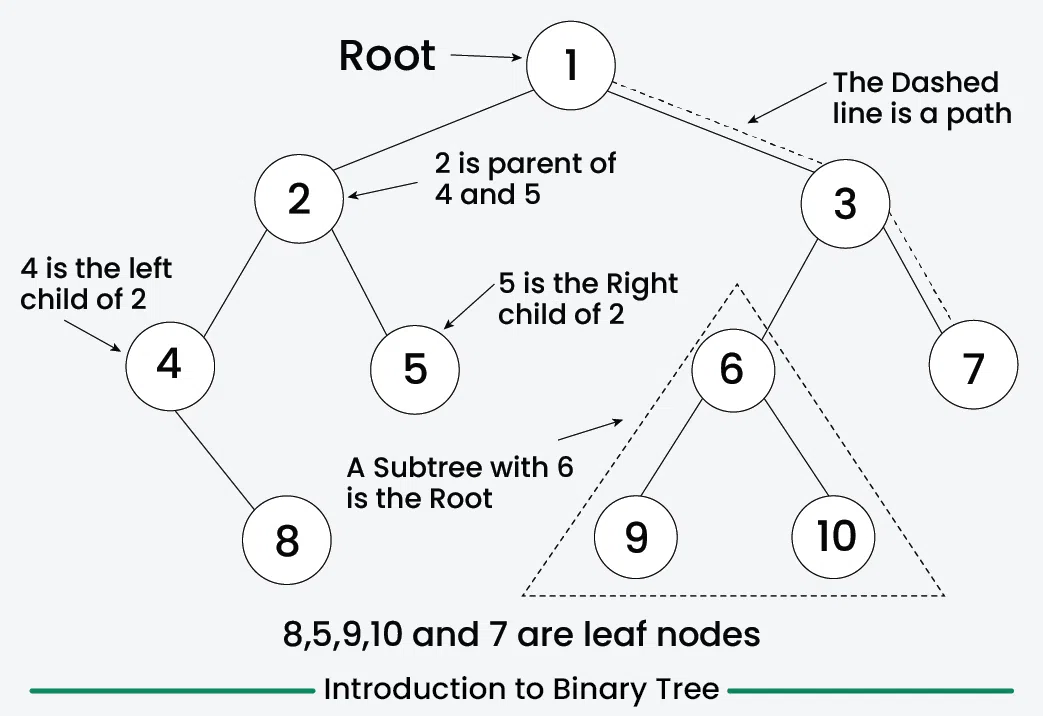
Traversals: Inorder (left-root-right), Preorder (root-left-right), Postorder (left-right-root).
Inorder Traversal (Problem 94)
Recursive:
def inorderTraversal(root):
    result = []
    def inorder(node):
        if node:
            inorder(node.left)
            result.append(node.val)
            inorder(node.right)
    inorder(root)
    return result
Iterative with stack.
Maximum Depth of Binary Tree (Problem 104)
def maxDepth(root):
    if not root:
        return 0
    return 1 + max(maxDepth(root.left), maxDepth(root.right))
Invert Binary Tree (Problem 226)
def invertTree(root):
    if root:
        root.left, root.right = invertTree(root.right), invertTree(root.left)
    return root
Binary Search Trees (BST): Left < root < right. For sorted operations.
Validate BST (Problem 98)
def isValidBST(root, low=float('-inf'), high=float('inf')):
    if not root:
        return True
    if not (low < root.val < high):
        return False
    return isValidBST(root.left, low, root.val) and isValidBST(root.right, root.val, high)
Practice 50+ tree problems. Trees model hierarchies like file systems.
Graphs: Connected DSA with Python
Graphs: Nodes and edges. Use adjacency list: dict of lists.
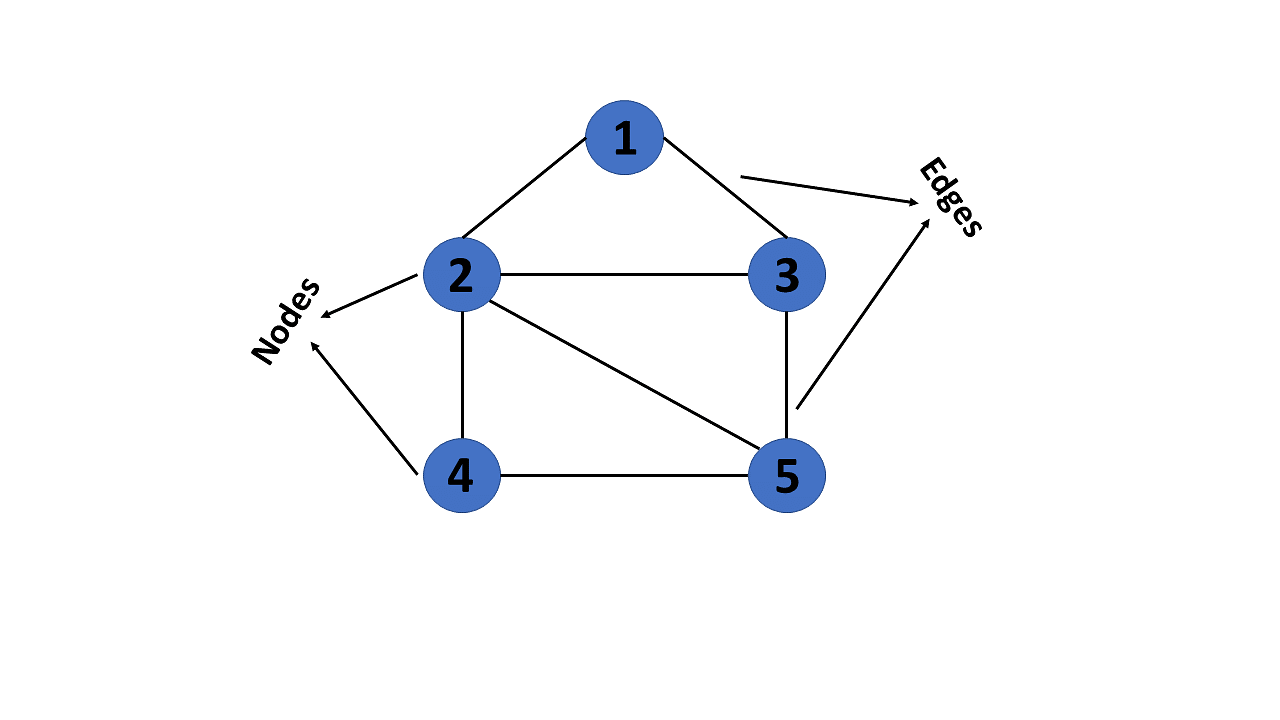
BFS: Queue for shortest path.
DFS: Stack/recursion for traversal.
Number of Islands (Problem 200)
Grid as graph, count connected '1's.
def numIslands(grid):
    if not grid:
        return 0
    rows, cols = len(grid), len(grid[0])
    visit = set()
    islands = 0

    def bfs(r, c):
        q = collections.deque()
        visit.add((r, c))
        q.append((r, c))
        while q:
            row, col = q.popleft()
            directions = [[1,0],[-1,0],[0,1],[0,-1]]
            for dr, dc in directions:
                nr, nc = row + dr, col + dc
                if (0 <= nr < rows and 0 <= nc < cols and
                    grid[nr][nc] == '1' and (nr, nc) not in visit):
                    q.append((nr, nc))
                    visit.add((nr, nc))

    for r in range(rows):
        for c in range(cols):
            if grid[r][c] == '1' and (r, c) not in visit:
                bfs(r, c)
                islands += 1
    return islands
DFS version recursive.
Clone Graph (Problem 133)
Use DFS with visited dict.
Graphs for networks, social media. Practice 40+ problems.
Sorting and Searching: Core Algorithms in DSA with Python
Sorting: Arrange data. Python's sorted() is timsort, O(n log n).
Implement Bubble Sort (O(n^2)) for understanding, but use efficient ones.
Merge Sort:
Divide and conquer.
Searching: Binary search on sorted arrays, O(log n).
Search in Rotated Sorted Array (Problem 33)
def search(nums, target):
    left, right = 0, len(nums) - 1
    while left <= right:
        mid = (left + right) // 2
        if nums[mid] == target:
            return mid
        if nums[left] <= nums[mid]:
            if nums[left] <= target < nums[mid]:
                right = mid - 1
            else:
                left = mid + 1
        else:
            if nums[mid] < target <= nums[right]:
                left = mid + 1
            else:
                right = mid - 1
    return -1
Handles rotation.
Practice quicksort, heapsort too.
Dynamic Programming: Optimization in DSA with Python
DP: Break problems into subproblems, store results to avoid recomputation.
Memoization or tabulation.
Climbing Stairs (Problem 70)
Ways to climb n stairs, 1 or 2 steps.
def climbStairs(n):
    if n <= 2:
        return n
    dp = [0] * (n + 1)
    dp[1], dp[2] = 1, 2
    for i in range(3, n + 1):
        dp[i] = dp[i-1] + dp[i-2]
    return dp[n]
Fibonacci-like.
House Robber (Problem 198)
Max amount without robbing adjacent.
def rob(nums):
    if not nums:
        return 0
    n = len(nums)
    if n <= 2:
        return max(nums)
    dp = [0] * n
    dp[0], dp[1] = nums[0], max(nums[0], nums[1])
    for i in range(2, n):
        dp[i] = max(dp[i-1], dp[i-2] + nums[i])
    return dp[-1]
Longest Increasing Subsequence (Problem 300)
O(n log n) with patience sorting, but standard DP O(n^2).
DP is tough but rewarding. Practice 50+ problems like knapsack, LCS.
300+ LeetCode Problems Solved: Patterns and Examples
To master DSA with Python, solve systematically. From web sources, Blind 75 is a curated list of 75 essential problems. Expand to Top 150 or Grind 169 for more.
Categories:
- Arrays: Two Sum, 3Sum, Container With Most Water.
- Strings: Longest Palindromic Substring, String to Integer.
- Linked Lists: Add Two Numbers, Remove Nth from End.
- Stacks: Next Greater Element, Daily Temperatures.
- Trees: Diameter of Binary Tree, Balanced Binary Tree.
- Graphs: Course Schedule, Word Ladder.
- DP: Unique Paths, Coin Change.
- Sorting/Searching: Kth Largest Element, Merge Intervals.
- Others: Bit Manipulation (Single Number), Backtracking (Subsets).
For each, understand the pattern. For example, in graphs, BFS for levels, DFS for paths.
We've solved examples above; practice the rest on LeetCode. Track progress: Aim for 10 problems/day.
Common patterns from sources:
- Two Pointers: For sorted arrays/strings.
- Sliding Window: Subarray problems.
- Prefix Sum: Range sums.
- Greedy: Optimal choices locally.
- Backtracking: Explore all possibilities.
Apply to 300+ problems. Videos solve 70+ in Python.
Placement Preparation Tips for 2026
For 2026 placements, start early. Campus seasons begin mid-2025.
- Build resume: Projects using DSA with Python, like pathfinding app.
- Mock interviews: Platforms like Pramp.
- Company-specific: Amazon loves trees/graphs, Google DP.
- Time management: Solve in 20-30 mins.
- Explain code: Verbalize thought process.
- Resources: GeeksforGeeks, LeetCode Discuss.
Stay updated with trends – AI/ML, but DSA core.

Conclusion
Mastering DSA with Python is achievable with consistent practice. By solving 300+ LeetCode problems, you'll be ready for 2026 placements. Remember, it's about understanding, not memorizing. Happy coding!